


Written by Vertical Pro Sdn Bhd.
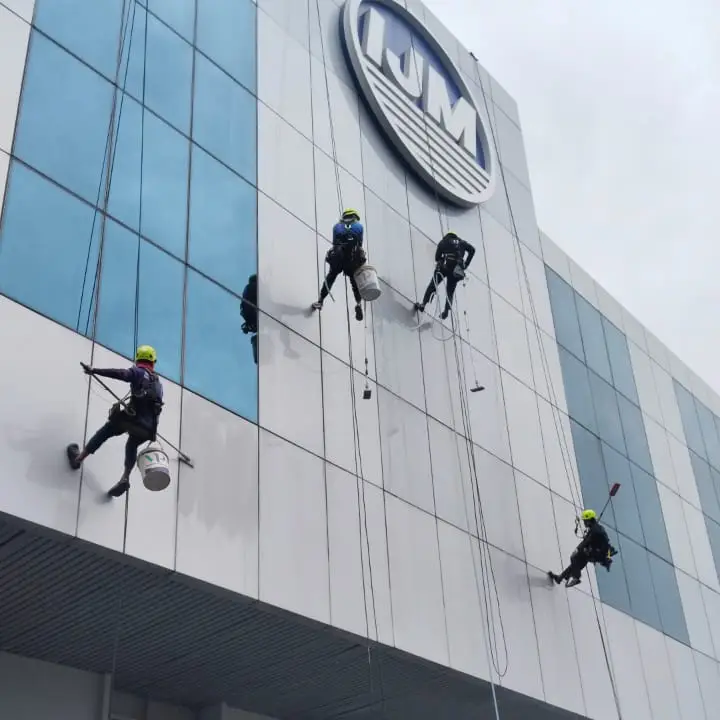
Reading Time: 9 minutesRope access Malaysia projects use planned rope systems to position trained technicians at high or difficult work areas. The method can support inspection, cleaning, sealant work and maintenance, but it is not automatically suitable for every building or task.
The quick answer for building managers: treat rope access as an access system, not a shortcut. Suitability depends on anchors, rope paths, technician competency, equipment, rescue, public protection and the tools required at the work face.
What Is Rope Access?
Rope access is a method of reaching and positioning personnel using ropes, harnesses, connectors and associated equipment within a controlled work system. It is commonly used where a technician needs close access to an elevation, roof edge, structure or confined external feature.
A professional rope access Malaysia project includes more than the visible ropes. It requires a site assessment, planned anchorage, equipment checks, trained personnel, supervision, exclusion zones, communication and a rescue arrangement for the actual work position.
How Rope Access Works at a High Level
Technicians work within a system that normally uses separate support and safety arrangements, together with equipment for controlled movement and positioning. The exact configuration follows the building, task, recognised work system and competent team’s plan.
Before anyone moves into position, the team confirms anchors, rope routes, edges, equipment, weather, communication, public protection and recovery. Operational rigging details should be designed and managed by competent personnel; they should not be improvised from a general article.
Where Rope Access Is Commonly Used
| Service | How rope access may help | Separate task requirement |
|---|---|---|
| Facade cleaning | Positions technicians close to glass, panels and architectural features | Surface identification, test area, water and runoff control |
| External window cleaning | Provides access to upper or recessed glazing | Glass coatings, tools, dry finish and open-window management |
| Facade inspection | Allows close visual access and location-specific photographs | Defined checklist, coverage, defect terminology and reporting |
| Sealant replacement | Reaches perimeter joints and difficult interfaces | Removal, preparation, product selection, curing and quality checks |
| Painting and coating | Provides local access to elevated surfaces | Substrate preparation, material handling, overspray and weather limits |
| Bird netting or signage | Reaches upper ledges, frames and building-mounted features | Fixing design, electrical interfaces and maintenance access |
Rope access solves positioning. It does not replace the technical method for cleaning, inspection, waterproofing or repair.
12 Smart, Essential Planning Checks
1. Define the task and work area
Start with the outcome: which elevations, levels, components and defects are in scope? Mark included and excluded areas on photographs or drawings. Task duration, tools, liquids, replacement materials and required force all influence access suitability.
A rope access Malaysia proposal should not rely on “all high-level work” as its only description. Clear boundaries help the team plan rope paths, staffing, rescue and public controls.
2. Survey the building and surroundings
Review roof access, parapets, fragile surfaces, equipment, setbacks, canopies, signs, roads, entrances, neighbouring property and tenant areas. A building that looks simple from the ground may contain deep recesses or roof restrictions that change the method.
Record available drawings, building-maintenance systems and anchor information. The rope access Malaysia survey should identify assumptions that must be confirmed before mobilisation.
3. Verify anchorage arrangements
Existing anchors should not be accepted from appearance alone. The rope access Malaysia contractor needs appropriate evidence, inspection and planning for the intended system. Temporary or engineered anchors require suitable design and control.
For a rope access Malaysia tender, building management should share available anchor records and identify any restricted roof zones. Uncertainty must be resolved before reliance.
4. Plan rope routes and work positioning
The path should account for edges, abrasion, heat, chemicals, façade projections, pendulum movement and loads on fragile finishes. Technicians must be able to reach and work at the task area with controlled tools.
Access to an elevation is not the same as a usable work position. Deep overhangs, wide fins and setbacks may need deviations, alternative access or a revised scope.
5. Confirm competent personnel and supervision
For rope access Malaysia procurement, ask which training, competency and supervision records apply to the proposed system and task. Verify current documents required by your organisation instead of repeating unsupported certification claims.
The rope access Malaysia supervisor should understand the site plan, stop-work authority, communication with the building representative and the technical limits of the task.
6. Inspect and control equipment
The rope access Malaysia work plan should address equipment selection, inspection, storage, compatibility and quarantine of damaged items. Task tools and materials also need control so they can be used without creating falling-object or handling hazards.
Heavy machines, large panels or unstable liquid containers may make another access method more suitable. The task load must be considered during planning, not added informally on site.
7. Prepare a site-specific rescue plan
Rescue should address recovery from the actual position using available personnel, equipment and routes. Setbacks, canopies, locked rooms and roof restrictions can change how a technician is reached.
A rope access Malaysia rescue plan that only says “call emergency services” does not describe immediate recovery from the work system. Relevant building contacts and access arrangements should also be confirmed.
8. Protect people and property below
Assess pedestrians, roads, vehicles, entrances, tenant areas, machinery and landscaping. Controls may include barriers, spotters, controlled tools, temporary diversion, overhead protection or restricted working hours.
Malaysia’s Department of Occupational Safety and Health provides guidance on preventing falls at workplaces. Site documents should match the actual exposure and selected access system.
9. Set weather limits
Wind, rain, lightning and heat can affect technician exposure, rope movement, tools and task quality. The rope access Malaysia method should identify monitoring, stop-work authority, equipment security and the process for resuming.
Weather limits may differ between cleaning, sealant, inspection and coating work. The rope-access decision and product requirements should be reviewed together.
10. Coordinate occupants and operations
Security may control roof keys and permits. Tenants may need notices about windows, privacy or balcony items. Hotels, hospitals, factories and offices may have different quiet periods, hygiene rules or operational restrictions.
A practical rope access Malaysia programme assigns notices, escorts, permits, water or power interfaces and emergency contacts before the team arrives.
11. Match task controls to access controls
Cleaning needs water and surface controls. Sealant work needs removal, preparation and curing. Painting needs material handling, overspray and weather control. Inspection needs coverage, terminology and photographs.
The rope access Malaysia method statement and risk assessment should describe both positioning and the actual service. A generic rope procedure cannot substitute for a task-specific work method.
12. Define reporting and handover
Agree on progress records, photographs, completed zones, inaccessible areas, visible defects and acceptance criteria. Use block, elevation, drop and level labels so reported items can be located later.
The rope access Malaysia handover should show what was done, what remains and which conditions need a separate specialist—not merely “work completed”.
Rope Access Compared with Other Methods
| Factor | Rope access | Mobile platform | Scaffold |
|---|---|---|---|
| Setup | Depends on anchors, roof access and rope routes | Requires machine delivery and stable ground | Requires erection, inspection and larger setup |
| Ground footprint | Often smaller, with exclusion zone still required | Needs machine and outrigger space | Usually larger and longer-term |
| Work position | Flexible on suitable vertical elevations | Stable basket where reach permits | Platform access across erected bays |
| Load capacity | Best for controllable personnel, tools and materials | Can support tools within machine limits | May suit heavier or repeated multi-trade work |
| Key limitation | Anchors, rescue, rope paths and positioning | Ground, reach geometry and obstacles | Footprint, time, public access and disruption |
In rope access Malaysia planning, no method wins every comparison. The building, task, duration and risk controls determine suitability. Drone inspection can also support overview imagery, but it does not provide physical work positioning or close touch-based checks.
Advantages Without the Marketing Hype
Smaller setup footprint: useful where entrances, parking or roads limit large access systems, while still requiring controlled ground space.
Close access to local areas: technicians may move between façade features that are difficult for a platform to approach.
Phased work: targeted inspection or repair can be organised by elevation or defect zone.
Visual documentation: technicians can photograph the work face when reporting is included.
For rope access Malaysia projects, these advantages are conditional. They do not mean rope access Malaysia work is automatically faster, cheaper or safer than every alternative. A site assessment must confirm the claim for the actual project.
Common Misunderstandings
“It is just abseiling.” Professional work requires a managed system, competent team, supervision, equipment control and rescue planning.
“Ropes can reach anywhere.” Anchors, edges, geometry, pendulum movement and work position create real limits.
“No ground control is needed.” Exclusion zones and falling-object controls remain important.
“One method statement covers every service.” Cleaning, inspection, sealant and painting have different task controls.
“Rope access is always cheapest.” Anchor work, rescue, setups, surface treatment and project duration affect the total.
How to Choose a Rope Access Contractor
- Ask the rope access Malaysia contractor for a site assessment and clear work boundaries.
- Verify relevant company, insurance, competency and equipment records.
- Review anchors, access, rescue and public-protection arrangements.
- Confirm the technical method for the actual cleaning, inspection or repair.
- Check weather limits, tenant notices and stop-work authority.
- Request assumptions, exclusions, photographs and handover records.
- Compare the proposed access with realistic alternatives.
What Affects Rope Access Cost?
Cost depends on the building height and geometry, number of setups, anchor arrangements, task, tools, materials, rescue, public protection, working hours, weather, tenant coordination and reporting. A local repair at ten locations may require more repositioning than a continuous cleaning drop.
For comparable rope access Malaysia quotations, provide the same elevation photographs, scope and deliverables. Ask whether anchor assessment, mobilisation, barriers, task materials, tests and touch-ups are included.
Who Does What on a Rope Access Project?
Clear roles prevent gaps between the contractor and the building team. A rope access Malaysia project may involve property management, security, engineering staff, the rope-access supervisor, technicians and a specialist responsible for the task result.
| Role | Typical responsibility |
|---|---|
| Building representative | Confirms scope, access, operating restrictions and acceptance route |
| Security or operations | Controls keys, permits, escorts, traffic and tenant communication |
| Rope-access supervisor | Manages the access system, team, pre-start, weather and rescue readiness |
| Technicians | Follow the approved access and task method, communicate changes and report defects |
| Task specialist | Defines cleaning, inspection, sealant, coating or repair quality requirements |
| Client inspector or consultant | Reviews tests, reports or completed work where included |
One person may hold more than one role, but responsibility should still be explicit. For example, an access-qualified technician should not make an engineering conclusion unless that role and qualification are also established.
Information to Provide for a Site Assessment
Good information helps a rope access Malaysia contractor decide whether a survey, anchor review or alternative access method is needed. Share what is known and label assumptions rather than guessing.
- Building address, use, height and number of blocks.
- Elevation, roof, parapet and ground photographs.
- The exact inspection, cleaning or repair objective.
- Available anchor, roof and building-maintenance-system records.
- Known façade defects, fragile areas and previous repairs.
- Entrances, roads, tenant areas and working-hour restrictions.
- Required permits, inductions, insurance and reporting.
- Water, power, storage or material-handling requirements.
If the work area cannot be seen clearly from a safe location, the first visit may be an access assessment or inspection rather than a fixed-price repair. That distinction should appear in the proposal.
Daily Pre-Start Questions
Even an approved rope access Malaysia method needs a current pre-start check. Weather, access and building operations can change between the survey and the workday.
- Which elevation, drop and task will be completed today?
- Are anchors, rope paths, edges and access doors available as planned?
- Does the team and equipment match the rescue arrangement?
- Are weather conditions within the agreed limits?
- Are exclusion zones, spotters and traffic controls ready?
- Have tenant windows, balconies or restricted areas changed?
- Are task products, tools and test results confirmed?
- Can technicians, roof support, ground support and management communicate?
Record material changes and revise documents where necessary. Moving from inspection to repair, adding heavy tools or changing the access route can alter risk and rescue requirements.
Using Rope Access in a Maintenance Programme
Rope access can support planned maintenance when records are organised by block, elevation, drop and level. The rope access Malaysia team can revisit a photographed joint, panel or stain without repeating the entire survey.
| Stage | Possible rope-access role | Useful record |
|---|---|---|
| Initial assessment | Reach difficult areas and document visible condition | Location-labelled photographs and coverage map |
| Planning | Confirm work position and access limits for proposed repair | Access notes, test area and quantities |
| Maintenance | Carry out approved cleaning or repair task | Daily progress, materials and completed zones |
| Quality check | Return to specified locations for close review | Before-and-after details and acceptance notes |
| Next cycle | Reinspect recurring or weather-exposed areas | Comparison with the same viewpoints |
This approach connects rope access Malaysia work to façade maintenance instead of treating each mobilisation as an isolated event. It also helps building managers budget work by condition and priority.
Red Flags in a Rope Access Proposal
- No site survey, roof information or marked scope.
- Existing anchors accepted without supporting information.
- No explanation of work position or difficult façade geometry.
- Competency claims without current records.
- A rescue plan that only says to call emergency services.
- No protection for pedestrians, roads or tenant areas.
- The same method statement used for unrelated tasks.
- No photographs, inaccessible-area record or handover standard.
Questions do not automatically disqualify a bidder. They help confirm whether the rope access Malaysia proposal reflects the actual building and task.
Before award, record the selected access method, agreed task, exclusions and clarification answers in the purchase order or scope attachment. This gives the supervisor and building representative the same reference when mobilisation begins.
Frequently Asked Questions
Is rope access suitable for every high-rise?
No. Suitable anchors, rope routes, work position, rescue and task requirements must be confirmed. Other access methods may be better for some buildings.
Is rope access safer than scaffolding?
No method is automatically safest in every situation. Safety depends on design, suitability, competent personnel, inspection, rescue and site controls.
Can rope access technicians inspect a façade?
Yes, where the inspection scope, technician role, coverage, photographs and reporting standard are defined. Engineering conclusions require the appropriate qualified professional.
Can rope access be used for sealant replacement?
Potentially. The access assessment and the sealant method—including removal, preparation, product, weather, curing and inspection—must both be suitable.
How is a technician rescued?
The competent team prepares a site-specific plan using the people, equipment and routes available for the actual work position. Details vary by building and task.
Does rope access damage a building?
The plan should protect edges, cladding, glass, coatings and roof surfaces from ropes, equipment and task materials. Existing defects and fragile finishes need identification before work.
How long does a rope access project take?
Duration depends on setups, elevation area, task complexity, surface condition, weather, access hours and reporting. A site assessment is needed for a realistic programme.
Request a Rope Access Site Assessment
Vertical Pro Sdn Bhd provides rope access services for suitable inspection, cleaning and exterior-maintenance work in Malaysia.
To discuss a rope access Malaysia project, share the building location, height, elevation photographs, intended task, roof or anchor information and operating restrictions. The final access method should follow a site assessment.