


Written by Vertical Pro Sdn Bhd.
Reading Time: 7 minutesQuick answer: Commercial facade cleaning should be selected according to the surface, contamination and condition of each elevation. Glass, aluminium, ACP, concrete, paint, stone and coated metal can react very differently to the same chemical, brush or pressure. Identify the material, inspect it and approve a test area before full production.
A modern commercial building often looks like one continuous exterior, but it may contain six or seven materials within a few metres. A glass curtain wall can include coated glass, powder-coated frames, silicone joints, metal flashings and stone at the podium. Treating all of them as a single washable surface is one of the easiest ways to create streaks, discolouration or avoidable damage.
Why material identification comes first in commercial facade cleaning
Commercial facade cleaning is not simply a question of choosing between water and detergent. The team also needs to know whether a finish is porous, coated, polished, painted, anodised, weathered or already damaged. Construction drawings, operation manuals and product information can help, but a site inspection remains important because materials and repairs may have changed over time.
| Material | Common contamination | Typical starting approach | Main risk to check |
|---|---|---|---|
| Glass | Traffic film, rain marks, dust, mineral deposits | Suitable water-and-tool process after inspection | Scratching, coating damage, seal or frame contact |
| Aluminium | Dust, run-off streaks, oxidation marks | Mild compatible cleaner and controlled agitation | Staining, finish change and reaction with adjacent materials |
| ACP | Atmospheric film, streaking, organic deposits | Low-aggression wash after coating check | Gloss change, abrasion, edge or joint water entry |
| Concrete | Dirt, algae, run-off marks, efflorescence | Diagnosis-led cleaning and local testing | Surface erosion, patchiness and forcing water into cracks |
| Painted surface | Chalking, dust, mildew, stains | Gentle test that separates dirt from paint failure | Paint loss, colour change and uneven sheen |
| Stone | Soiling, organic growth, mineral staining | Stone-specific assessment and discreet test | Etching, salt movement, staining and joint damage |
| Coated metal panel | Atmospheric dirt and drainage streaks | Finish-compatible cleaner with soft tools | Coating damage, corrosion exposure and scratching |
9 essential material and method checks
1. Glass: check coatings, deposits and surrounding seals
Ordinary-looking glass may have a surface treatment or coating that limits the tools and products that can be used. Inspect for scratches, chips, hard-water deposits and existing construction residue. Frames, gaskets and silicone joints must be considered too, because runoff from one component can mark another.
For routine commercial facade cleaning, begin with the least aggressive process capable of removing the identified contamination. Do not assume that a blade, abrasive pad or strong chemical is acceptable simply because it works on uncoated glass elsewhere.
2. Aluminium: distinguish dirt from finish deterioration
Aluminium frames and panels may be anodised, powder coated or finished in another system. Weathered aluminium can show oxidation, fading or patchy gloss that cleaning will not reverse. A contractor should explain what is removable contamination and what is a change in the finish itself.
Product concentration, contact time and rinsing matter. Allowing cleaner to dry on a warm façade can leave uneven marks. Adjacent glass and sealant should be included in the test because runoff crosses material boundaries.
3. ACP: protect the coating and panel edges
Aluminium composite panels are valued for a consistent factory finish, so aggressive scrubbing or unsuitable chemicals can create a visible difference between cleaned and untreated areas. Confirm the panel and coating information where available, and test colour and gloss after the sample has fully dried.
Panel joints, folded edges and sealant lines deserve attention. Commercial facade cleaning should remove surface deposits without directing unnecessary pressure into openings or vulnerable interfaces.
4. Concrete: understand the stain before increasing pressure
Concrete is porous and its appearance varies naturally. Dark run-off, algae, rust marks, efflorescence and old repairs have different causes. High pressure may brighten one strip while eroding the surface, exposing aggregate or driving water into a crack.
Begin by mapping cracks, spalls, previous patches and active water marks. Cleaning can improve visibility for a later inspection, but it is not a repair for leakage, corrosion or loose concrete. Potentially unsafe defects require an appropriate technical assessment.
5. Painted surfaces: decide whether the coating is sound
Chalking paint can leave colour on a cloth even before cleaning. Peeling, blistering and weak adhesion may worsen with water or agitation. A small test helps determine whether the visible problem is surface dirt, biological growth or coating failure.
If the paint is nearing the end of its service life, the sensible scope may combine gentle cleaning with a separate repainting assessment. Promising a perfectly uniform result from washing alone would create the wrong expectation.
6. Stone: identify the stone and joint system
Natural and engineered stones vary in porosity, mineral composition and sensitivity. Acidic products can etch some surfaces; excessive wetting can mobilise salts; and strong agitation can change a polished finish. Joint material, anchors and previous sealers can influence the method as well.
Where the stone type or stain is uncertain, obtain specialist input instead of experimenting across a prominent elevation. A discreet sample should be judged for colour, sheen and drying pattern—not only for immediate dirt removal.
7. Coated metal panels: inspect scratches and corrosion
Factory-coated steel or aluminium panels can be durable, but once the coating is scratched or breached, corrosion may begin beneath or around the damaged area. Record existing scratches, edge corrosion and run-off from fixings before commercial facade cleaning starts.
Use soft tools and a compatible cleaner. The goal is to remove atmospheric deposits while preserving the coating. Rust staining may need investigation of the source rather than repeated aggressive treatment of the visible trail.
8. Interfaces: test where materials meet
Many problems occur at interfaces rather than in the middle of a panel. Cleaner used on stone can run over aluminium; dirty water from concrete can streak glass; and a brush can catch a weak sealant edge. Include representative interfaces in the sample area and plan the sequence from upper to lower zones.
Open joints, failed silicone, loose trims and damaged gaskets should be recorded. Cleaning crews can report visible conditions, but the cause and repair design may require a dedicated façade maintenance assessment.
9. Test, record and approve the final method
A useful commercial facade cleaning test records the product, dilution, water quality, temperature, dwell time, tools, agitation and rinse. Photograph the area before, immediately after and once dry. The building representative should agree what counts as an acceptable result and note stains or deterioration that cannot be corrected by cleaning.
Access and safety planning
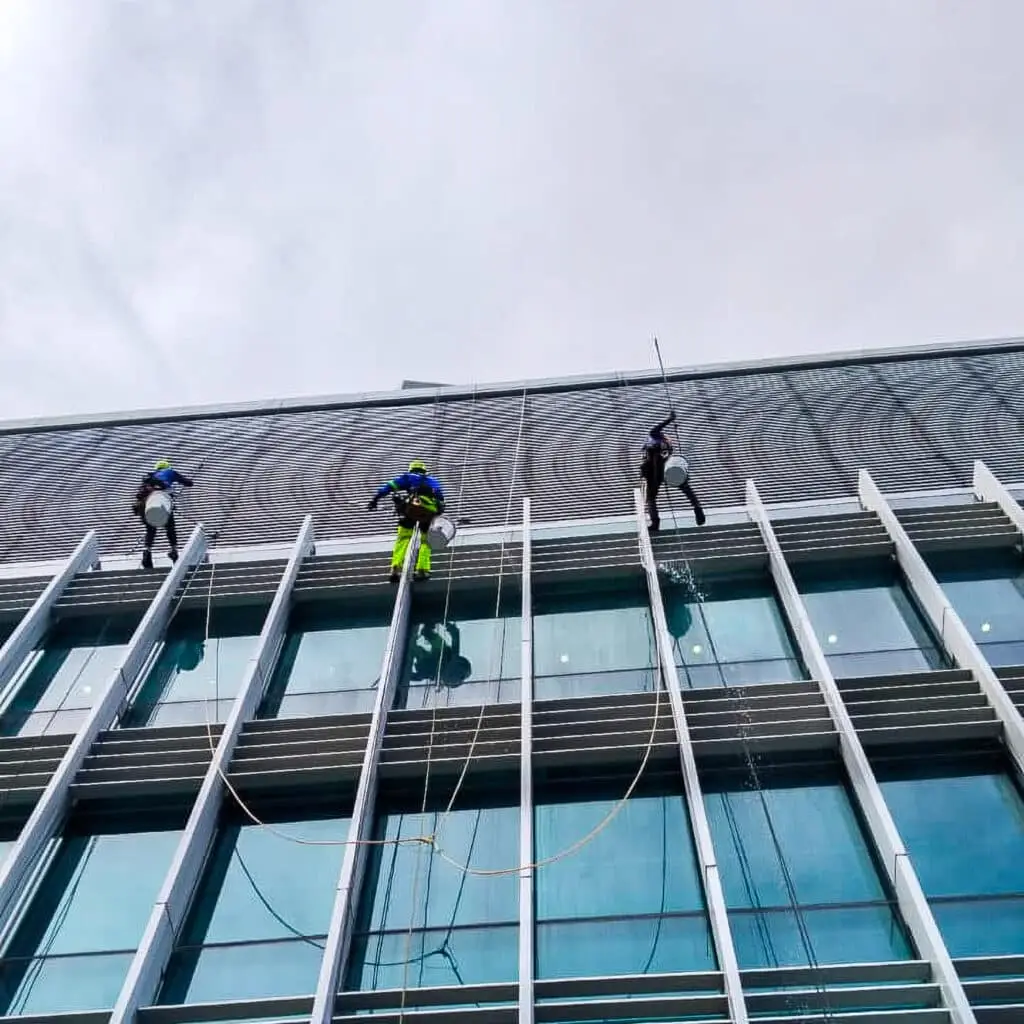
In commercial facade cleaning, the surface method and access method are separate decisions. Rope access may suit difficult vertical elevations; a MEWP may suit lower zones with firm ground; a BMU or gondola may serve areas within its designed reach; and scaffold may support long-duration work. Complex buildings often need more than one method.
Site planning should cover competent personnel, equipment, anchor or machine information, weather limits, rescue arrangements, secure tools and exclusion zones below. The Department of Occupational Safety and Health publishes guidance on the prevention of falls at workplaces. The project team must still confirm current requirements for the specific site and activity.
Water, runoff and environmental controls
Commercial facade cleaning can affect entrances, landscaping, air intakes, neighbouring property and drainage. Confirm the water source, hose route, collection or diversion needs and any restrictions on discharge. Protect vehicles, signs, electrical equipment and sensitive planting where necessary.
Water quality can also influence glass and dark panels. If a process is likely to leave mineral spots, the team should adjust the water treatment, rinse or drying method rather than trying to polish every mark later.
Quality control and handover
- Divide the building into named elevations and measurable zones.
- Approve representative test areas for each material and major stain type.
- Check completed zones from agreed internal and external viewpoints.
- Record inaccessible areas and explain the access limitation.
- Separate missed cleaning from permanent staining or finish deterioration.
- Photograph visible cracks, loose components or failed joints for follow-up.
- Provide a concise completion record and recommended review point.
Commercial facade cleaning acceptance should happen progressively, not only after the access equipment has left. Early checks allow the team to correct technique, sequencing or rinsing while the relevant zone is still active.
What affects commercial facade cleaning cost?
Cost depends on façade area, height, access, number of materials, contamination, testing, water availability, operating restrictions, public protection, working hours and reporting. Commercial facade cleaning on a building with several small material zones can take longer to manage than a larger but uniform glass elevation.
For a comparable quotation, give bidders the same drawings, photographs, material information, access restrictions and acceptance standard. A site assessment is normally needed before confirming the final method and programme.
Frequently asked questions
Can one chemical clean every façade material?
No. A product that works on one material may stain, etch, soften or dull another. Identify the surfaces and approve representative test areas before wider use.
Is pressure washing suitable for commercial façades?
Only where the material, condition, joints and surrounding risks allow it. Excessive pressure can damage coatings, erode porous surfaces or force water into cracks and interfaces. The pressure, distance and nozzle must be assessed and tested.
Why does a façade still look patchy after cleaning?
Possible reasons include permanent staining, uneven weathering, oxidation, coating failure, old repairs, different material batches or inconsistent drying. A test area helps set a realistic expectation before full work begins.
Can cleaning stop façade water leakage?
No. Cleaning may expose cracks or failed joints, but leakage needs diagnosis of the entry path and an appropriate repair. Do not use cleaning as a substitute for waterproofing or sealant assessment.
How often should commercial facade cleaning be arranged?
Frequency depends on location, traffic pollution, rainfall, nearby construction, orientation, material and presentation standards. Review how quickly each elevation becomes soiled and adapt the cycle to the site.
Should façade cleaning include an inspection?
During commercial facade cleaning, technicians can record visible defects encountered at close range. A formal façade inspection should have its own purpose, scope, competent personnel and report; it should not be implied by a standard cleaning quotation.
Can rope access technicians clean glass, ACP and stone in one visit?
They may be able to reach all three, but each material still needs an approved process, tools and sequence. Access capability does not make one cleaning method universally suitable.
Request a site assessment
Vertical Pro Sdn Bhd provides commercial facade cleaning and external façade cleaning services, supported by rope access services where suitable. Send the building location, recent photographs, known materials and operational restrictions so our team can review the scope and arrange a site assessment where required.