


Written by Vertical Pro Sdn Bhd.
Reading Time: 9 minutesHigh-rise window cleaning Kuala Lumpur projects need more than a team and squeegees. The plan must fit the tower’s glass, roof or ground access, busy entrances, traffic, tenant windows, weather and the required finish.
The quick answer for building managers: survey the actual elevations, test the glass method, choose access by reach and risk, coordinate occupants and public areas, then record completed zones and visible defects.
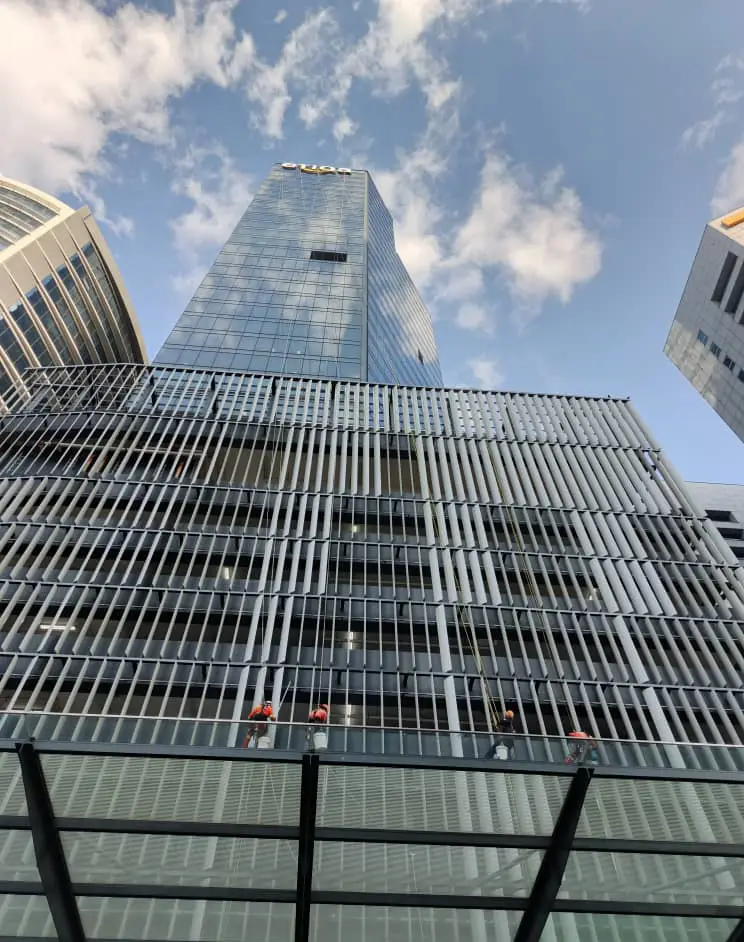
What Makes Kuala Lumpur Window Cleaning Different?
Kuala Lumpur combines tall glass buildings, heavy traffic, active construction, tropical rain, humidity and crowded ground-level spaces. A tower may face a main road on one side, a hotel drop-off on another and a shared podium below.
That means a high-rise window cleaning Kuala Lumpur scope often needs separate access and working-hour plans for each elevation. The visible staining may also differ: road-facing glass can collect traffic film, while sheltered façades develop organic deposits or water marks.
Buildings That Commonly Need the Service
- Office towers with curtain-wall glazing.
- Hotels with guest rooms and busy arrival areas.
- Condominiums with balconies and openable windows.
- Shopping centres with atriums, canopies and signage.
- Hospitals or institutional buildings with sensitive operations.
- Mixed-use developments with podiums, residences and retail.
- Industrial or technology buildings with high-level glazing.
Building type does not set one method. Geometry, glass, access, occupancy and surroundings determine the work plan.
10 Smart, Essential Local Checks
1. Mark the exact glass scope
Identify blocks, elevations, levels and glass faces. Clarify whether the scope includes external panes only or also frames, mullions, spandrels, canopies, balcony glass and internal atrium faces.
A high-rise window cleaning Kuala Lumpur quotation should state exclusions such as inaccessible recesses, damaged glass or special stain treatment. “All windows” is too vague for a complex tower.
2. Identify glass, coatings and existing condition
Glass may have factory coatings, applied films, tint, previous treatment or construction residue. Frames and sealants have separate cleaning limits. Record scratches, cracks, failed seals and permanent marks before work.
When the surface is uncertain, use a representative test area and inspect it after drying. Wet glass can hide haze and streaks temporarily.
3. Choose access for each elevation
Options include water-fed poles, mobile elevating work platforms, gondolas, scaffold and rope access services. Roof anchors, machine reach, ground bearing, setbacks, canopies and rescue influence the choice.
A high-rise window cleaning Kuala Lumpur project may combine methods. A platform can serve the podium while rope access reaches the tower, provided each method has suitable controls.
4. Plan around entrances and traffic
Map pedestrian routes, drop-off lanes, loading bays, car parks, public pavements and neighbouring property. Controls may include barriers, spotters, temporary diversion, restricted working hours or coordination with relevant site and authority requirements where applicable.
Do not assume one exclusion zone can remain in place all day. Morning office arrivals, hotel check-in, deliveries and evening traffic may require a phased programme.
5. Coordinate tenants and openable windows
Issue notices for window closure, balcony items, privacy and expected noise or water. Identify rooms, offices or medical areas that require special timing. State what happens when an occupant leaves a window open.
The high-rise window cleaning Kuala Lumpur plan should assign notices and follow-up to named building personnel instead of leaving technicians to solve occupant issues from the façade.
6. Review safety documents and rescue
Confirm the method statement, risk assessment, team competency, equipment records, public protection and rescue for the selected access. Documents should name the actual building and work zones.
Malaysia’s Department of Occupational Safety and Health provides guidance on preventing falls at workplaces. The contractor’s plan should be site-specific.
7. Control water, runoff and tools
State the water source, hose route, products, containers and runoff controls. Protect entrances, air intakes, electrical equipment, vehicles, landscaping and tenant goods.
A high-rise window cleaning Kuala Lumpur team should control squeegees, brushes, hoses and small fittings at height. The method needs to be workable from the technician’s actual position.
8. Set weather limits and programme allowance
Rain may affect finish and re-soil completed glass. Lightning, wind and heat affect work-at-height safety and productivity. The high-rise window cleaning Kuala Lumpur programme should include stop-work authority, equipment security and a realistic process for resuming.
A fixed completion date without weather allowance can encourage poor decisions. Agree on communication for postponed elevations and access changes.
9. Agree on the finish and stain limitations
Define whether the expected result is routine removal of loose and general dirt or specialist treatment of mineral deposits, adhesive, cement or paint. Test difficult marks before promising removal.
The high-rise window cleaning Kuala Lumpur completion standard should distinguish remaining contamination from glass damage, coating deterioration or scratches.
10. Record progress and visible defects
Use block, elevation and level labels for progress photographs. Record missed areas, access limitations, permanent marks and visible issues such as open sealant or cracked glass without making unsupported technical conclusions.
The high-rise window cleaning Kuala Lumpur handover should let another person understand what was cleaned and what needs follow-up.
Common Kuala Lumpur Contamination
| Condition | Likely location | Cleaning consideration |
|---|---|---|
| Traffic film and soot | Road-facing lower and mid elevations | Compatible cleaner, agitation and thorough rinse may be needed |
| Rain streaks | Below mullions, fins and façade projections | Check runoff paths and clean in a controlled sequence |
| Mineral marks | Areas with repeated water drying | Test specialist treatment; etched glass may not be restored |
| Construction dust | Near active development or refurbishment | Avoid dry scratching and assess bonded cement or paint separately |
| Organic growth | Shaded, humid or poorly rinsed areas | Use a surface-compatible treatment and manage runoff |
| Bird droppings | Ledges, signs and nearby perching points | Pre-wet, soften and use suitable hygiene controls |
Access Method Comparison for Urban Towers
| Method | May suit | KL site question |
|---|---|---|
| Water-fed pole | Reachable lower glass | Can the ground area and water runoff be controlled? |
| Mobile platform | Podiums and façades with clear ground access | Can the machine reach through traffic, paving and canopies? |
| Gondola or BMU | Towers served by a permanent system | Is it available, inspected and able to reach the full scope? |
| Rope access | Suitable high or complex elevations | Are anchors, rope paths, rescue and ground zones workable? |
| Scaffold | Long-duration cleaning combined with repair | Can entrances and public areas accommodate the footprint? |
How Often Should Windows Be Cleaned?
There is no single interval for every Kuala Lumpur building. Frequency depends on traffic, construction, rainfall, glass angle, sheltered areas, tenant expectations and brand standards.
| Condition | Planning response |
|---|---|
| Busy-road frontage | Inspect more often and compare soiling by elevation |
| Luxury hotel or retail entrance | Prioritise high-visibility lower glazing between full cleans |
| Construction nearby | Review during and after dusty work |
| Sheltered shaded façade | Watch for organic growth and slow drying |
| Upper tower with clean runoff | Use condition and appearance standard, not ground-level assumptions |
Start a high-rise window cleaning Kuala Lumpur schedule with inspection and photographs. Adjust it after observing the real rate of soiling.
Information to Include in a Request for Quotation
- Building address, use, blocks, height and elevations.
- Glass area, frames, balconies and internal faces included.
- Roof, anchor, gondola or ground-access information.
- Photographs of stains, construction residue and difficult geometry.
- Entrances, roads, tenant areas and restricted hours.
- Water points, drainage and product restrictions.
- Required test areas, safety documents and reporting.
- Known defects and areas requiring specialist review.
Issue the same high-rise window cleaning Kuala Lumpur information to every bidder. This makes access, duration, protection and price easier to compare.
What Affects Cost in Kuala Lumpur?
Cost depends on glass area, building height, number of setups, access system, public and traffic controls, contamination, test results, water supply, working hours, tenant coordination, weather and reporting.
A high-rise window cleaning Kuala Lumpur quotation should show assumptions and exclusions. Ask whether machine hire, anchor assessment, mobilisation, barriers, water, specialist stain treatment and touch-ups are included.
Questions to Ask Before Appointment
- Which elevations and glass faces are included?
- How will every area be reached?
- What training, insurance and equipment records apply?
- How will rescue and public protection work?
- Which glass method and test area are proposed?
- How will open windows, tenants and privacy be managed?
- What weather limits and delay process apply?
- Which photographs and defect notes will be provided?
Planning Around Kuala Lumpur Building Operations
Urban towers rarely offer one uninterrupted work zone. A high-rise window cleaning Kuala Lumpur plan should divide the building into practical areas and match each one to the site’s busiest periods.
| Interface | Typical concern | Planning response |
|---|---|---|
| Office entrance | Morning arrival and evening departure peaks | Phase work, move barriers or use an alternative elevation |
| Hotel drop-off | Guests, vehicles, luggage and privacy | Coordinate short closures with operations and guest services |
| Condominium balconies | Open windows, personal items and resident privacy | Issue notices, set a contact route and record non-compliant units |
| Retail frontage | Customer access, signage and trading hours | Use early or off-peak windows and protect shop entrances |
| Loading bay | Delivery vehicles and reversing movements | Coordinate bookings, spotters and temporary exclusion |
| Road or public edge | Traffic and people outside direct building control | Assess relevant site and authority requirements before mobilisation |
| Air intake or plant area | Water, chemical mist and equipment access | Protect or sequence work with the engineering team |
Put the agreed restrictions into the method and programme. A verbal instruction given after ropes or a platform are set up can cause unnecessary delay and a rushed change.
Example Elevation-by-Elevation Programme
The following is a planning example, not a fixed schedule. The actual high-rise window cleaning Kuala Lumpur programme follows the building, weather and selected access method.
- Day 1 setup and test: confirm access, ground zone, glass method and dry test result.
- Road-facing elevation: work during the agreed lower-traffic period with ground coordination.
- Main entrance elevation: phase drops or temporarily move to another face during arrival peaks.
- Residential or hotel elevation: follow window and privacy notices, logging units that cannot be cleaned.
- Podium and canopy: change to a platform, pole or controlled ground method if the tower system cannot reach.
- Final review: inspect completed glass from agreed viewpoints and close touch-up items.
A good programme shows how crews move between elevations and how each access change is controlled. It should also explain which activities can continue when one face is stopped by weather or occupancy.
Pre-Start Meeting Checklist
Meet briefly with property management, security, engineering and the high-rise window cleaning Kuala Lumpur supervisor before mobilisation. Confirm the approved documents and the practical arrangements below.
- Team names, supervisor and emergency contacts.
- Roof keys, permits, inductions and restricted plant zones.
- Anchor, gondola, platform or machine arrangements.
- Rescue, communication and weather monitoring.
- Ground barriers, traffic, deliveries and public routes.
- Tenant notices, open windows, balconies and privacy.
- Water points, hose routes, drains and protected equipment.
- Test area, products, tools and accepted cleaning result.
- Daily progress photographs and defect reporting.
If the site differs from the survey, update the method or scope before work. A change from gondola to rope access, for example, affects equipment, competency, rescue and the roof plan.
Records That Improve the Next Cleaning Cycle
Keep the agreed scope, test-area result, completed elevations, weather delays, inaccessible panes, permanent marks and tenant issues. Use the same photograph viewpoints over time.
These records show whether one elevation soils faster, whether the interval is appropriate and whether a different access setup would be more efficient. The next high-rise window cleaning Kuala Lumpur tender can then use actual quantities and constraints instead of starting again.
Red Flags in a Local Cleaning Proposal
- No site visit or elevation photographs.
- One access method promised for every façade without reach checks.
- No plan for the main entrance, roads or tenant windows.
- No glass identification or test area.
- No weather allowance despite work-at-height exposure.
- Every stain guaranteed to disappear.
- No rescue, equipment records or controlled ground zone.
- No completion map, photographs or inaccessible-area record.
A transparent limitation is more useful than a vague “all included” promise. Ask the high-rise window cleaning Kuala Lumpur contractor to attach clarification answers to the approved order.
Quick Building-Type Notes
Office towers: prioritise arrival periods, tenant windows, corporate events and loading access.
Hotels: coordinate guest privacy, room occupancy, drop-off operations and quiet periods.
Condominiums: use clear resident notices, balcony instructions and a process for locked or open windows.
Shopping centres: separate atrium, canopy, skylight and exterior glass; trading hours may require several work windows.
Mixed-use buildings: treat the podium, hotel, office and residential tower as connected but operationally different zones.
After-Service Review
Within the agreed handover period, review the high-rise window cleaning Kuala Lumpur result from selected ground and occupied-floor viewpoints. Check the completed-elevation map against the quotation before focusing on individual marks.
- Confirm blocks, elevations and glass faces completed.
- Review test-area expectations and any permanent marks.
- List missed or inaccessible panes separately from defects.
- Match defect photographs to block, elevation and level.
- Close tenant, privacy, traffic or water complaints.
- Record weather delays and the final completion date.
- Set the next condition review rather than copying the old interval automatically.
If touch-up work is needed, define the exact panes and access method. Avoid reopening the entire high-rise window cleaning Kuala Lumpur scope for a local issue that can be photographed and measured.
Store the final records with façade and sealant observations. Cleaning teams often have close visual access to areas the building team cannot see from inside, making accurate location notes valuable for future maintenance.
Frequently Asked Questions
How much does high-rise window cleaning cost in Kuala Lumpur?
There is no reliable flat rate for every tower. Area, height, access, contamination, traffic control, working hours and reporting affect price. A site assessment supports a useful quotation.
Is rope access required for every building?
No. Gondolas, platforms, poles or scaffold may be better depending on the building. The high-rise window cleaning Kuala Lumpur contractor should justify the access choice.
Can cleaning remove all hard-water marks?
Not always. Deposits may need specialist treatment, while etched or damaged glass may not be restored by cleaning. Test before promising removal.
Can work continue while offices or residences are occupied?
Often yes, with suitable notices, window controls, privacy measures, barriers and scheduling. The high-rise window cleaning Kuala Lumpur plan should reflect the occupants and ground areas.
What happens when it rains?
The high-rise window cleaning Kuala Lumpur method should define weather limits, stop-work decisions and how incomplete areas are rescheduled. Rain can also affect the dry finish.
Does window cleaning include sealant repair?
Not automatically. Cleaning may reveal failed sealant, but replacement needs a separate product, preparation, curing and quality scope.
Which areas of Kuala Lumpur does Vertical Pro serve?
Service availability depends on the building, access, scope and programme. Share the exact property location with Vertical Pro for confirmation rather than relying on a generic area list.
Request a Kuala Lumpur Site Assessment
Vertical Pro Sdn Bhd provides external window cleaning services and high-rise access support for suitable commercial, residential and managed properties in Kuala Lumpur.
To discuss high-rise window cleaning Kuala Lumpur requirements, share the address, building height, elevation photographs, glass areas, current access information and operating restrictions. The final method should follow a site assessment.