


Written by Vertical Pro Sdn Bhd.
Reading Time: 8 minutesRope access facade cleaning can be suitable for high-rise elevations where technicians need controlled access without a large ground footprint. Suitability still depends on verified anchors, a workable rope path, rescue arrangements, surface condition, public protection and the cleaning objective.
The quick answer for building managers: approve rope access only after a site-specific assessment explains how the team will reach every included area, protect people below, clean without damaging the façade and recover a technician if normal movement is not possible.
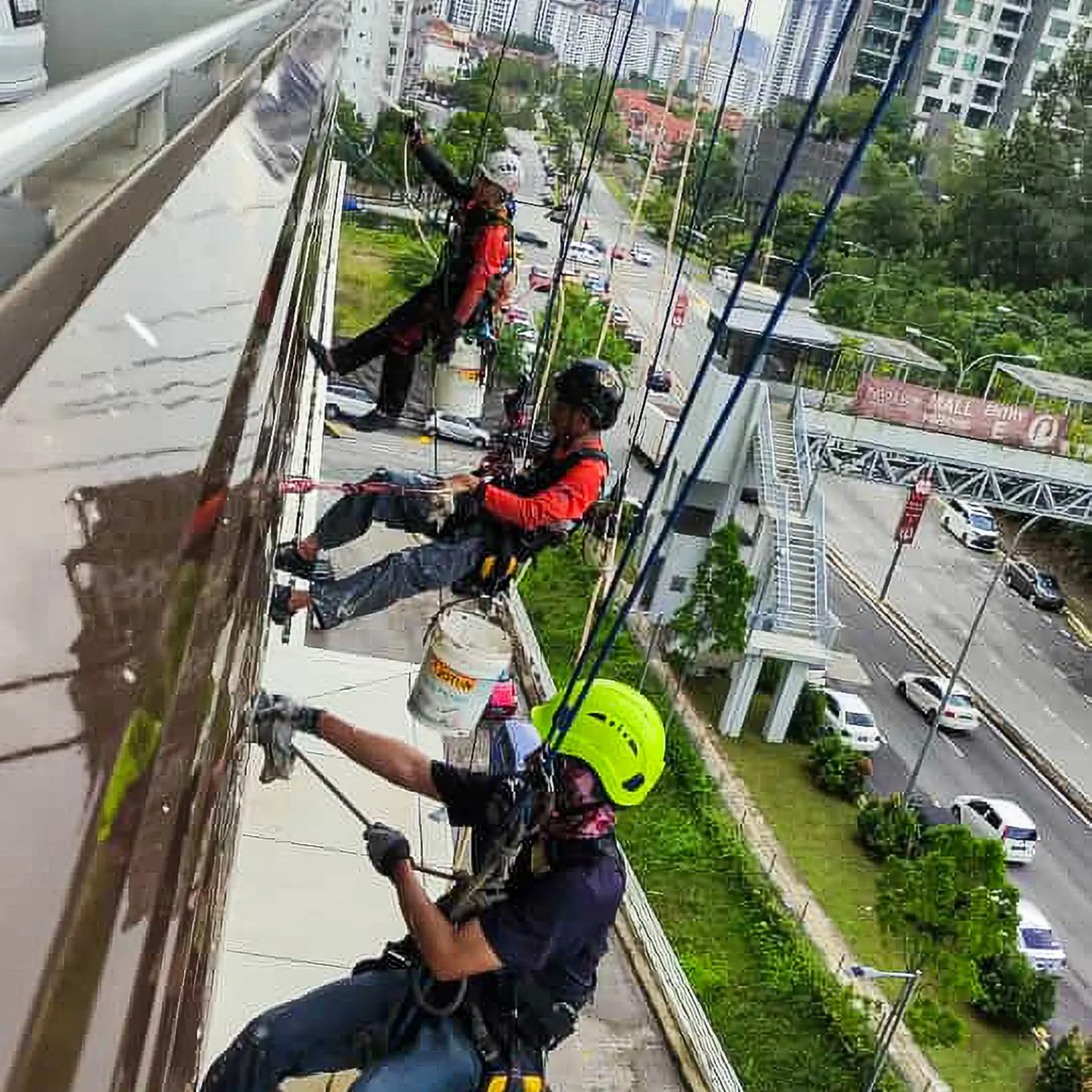
What Is Rope Access Facade Cleaning?
Rope access facade cleaning uses a planned system of ropes and associated equipment to position trained technicians at an exterior work area. It is an access method; the cleaning result still depends on correct surface identification, tools, products, water control and inspection.
A rope access facade cleaning scope may include glass, mullions, ACP, coated metal, painted concrete, louvres, fins and architectural features. No single cleaning solution or pressure setting suits all these materials.
When Rope Access May Be Appropriate
- The elevation is high, recessed or difficult to reach from the ground.
- Suitable anchors and rope paths can be established.
- The work can be completed from a controlled suspended position.
- Scaffold or a large mobile platform would create significant space or access constraints.
- The project needs technicians to move between local façade features.
- Public areas below can be protected with a practical exclusion plan.
It may be unsuitable where anchors cannot be verified, rope paths cross damaging edges, the technician cannot maintain a workable position, rescue is not practical or the task requires heavy equipment that cannot be controlled safely. A mobile platform, gondola or scaffold may be a better choice.
10 Critical Safety and Quality Checks
1. Define the exact cleaning scope
Mark the blocks, elevations, levels and surface types. Clarify whether frames, fins, spandrels, canopies, signage and recessed areas are included. Identify windows that open, balconies, tenant spaces and any area awaiting repair.
A rope access facade cleaning plan should use elevation photographs where possible. They show changes in geometry, rope deviations, public routes and material transitions more clearly than a phrase such as “all external surfaces”.
2. Verify anchors and supporting structure
The contractor should identify the intended anchors and the information used to accept them. Existing eye bolts, rails or building-maintenance systems should not be assumed suitable from appearance alone. Temporary or engineered arrangements require the appropriate design and control.
Building management should provide available anchor records, roof drawings and access information. If the condition or capacity is uncertain, the issue must be resolved before technicians rely on the system.
3. Plan rope paths and edge protection
Parapets, metal edges, cladding, glass, signage and roof equipment can affect the rope route. The method should address abrasion, sharp edges, heat sources, chemical contact and unintended loading on fragile finishes.
Rope paths should also account for pendulum movement, wind and the technician’s ability to reach the work face without uncontrolled swinging. These are planning matters for the competent rope-access team, not improvised decisions after descent begins.
4. Confirm team competency and supervision
Ask which training and competency records apply to the selected rope-access system, cleaning task and supervision. Verify current documents required by your procurement process rather than relying on unsupported claims.
The rope access facade cleaning supervisor should understand the approved scope, stop-work conditions, communication with building management and escalation of visible defects. Surface-cleaning knowledge matters alongside access skill.
5. Prepare a site-specific rescue plan
The rescue plan should address recovery from the actual work position using the team, equipment and access available on site. “Call emergency services” alone does not explain immediate recovery from suspension or a difficult façade recess.
Rescue arrangements may change by elevation. Locked roof zones, canopies, setbacks and internal access points should be considered before work starts, and relevant building personnel need emergency contacts.
6. Control falling objects and the work zone
Tools, squeegees, brushes, hoses, fittings and containers should be controlled for the task. The area below may need barriers, spotters, overhead protection, temporary road control or restricted hours depending on exposure.
Malaysia’s Department of Occupational Safety and Health publishes guidance on preventing falls at workplaces. The rope access facade cleaning controls should reflect the actual building and public area rather than a generic template.
7. Match the method to the façade material
Inspect the façade before selecting water pressure, brushes, pads or chemicals. Coated glass, aluminium, ACP, stone, painted surfaces and sealants have different limitations. Weak paint, cracked panels or failed joints may require a separate repair decision.
Use a representative test area when the surface, coating or contamination is uncertain. Review it after drying because water can temporarily hide haze, streaks or colour change.
8. Manage water, chemicals and runoff
The method should state the water source, hose route, cleaning products, dilution, containers and runoff controls. Open windows, air intakes, electrical equipment, entrances, gardens and neighbouring property may need protection.
A rope access facade cleaning technician must be able to handle the selected tools and liquid safely from the work position. Large, heavy or unstable equipment may change the suitability of rope access.
9. Set weather and communication rules
Wind, lightning, rain and heat can affect rope movement, technician exposure and cleaning quality. The plan should identify monitoring, stop-work authority, the process for securing equipment and how work resumes.
Communication should cover technicians, the supervisor, roof or ground support, security and the building representative. Test the selected system where the building shape or equipment may affect reception.
10. Inspect and report the result
Agree on the expected cleaning standard, inspection method and treatment of missed areas before work. Photographs should identify block, elevation and level. Large buildings may need progress records by drop or façade zone.
The rope access facade cleaning report should distinguish remaining stains from visible defects. A technician may document cracked sealant, corrosion or a loose component without making an unsupported structural conclusion.
Facade Material and Cleaning Considerations
| Material | Common deposits | Important check |
|---|---|---|
| Glass | Traffic film, water marks and mineral residue | Coatings, scratching risk, seals and dry finish |
| Aluminium or coated metal | Dust, oxidation marks and runoff streaks | Chalking, colour change and product compatibility |
| ACP | Atmospheric residue, algae and joint staining | Panel coating, weak sealant and water entry |
| Painted concrete | Organic growth, soot and rain streaks | Loose paint, cracks and uneven pressure marks |
| Stone | Dark staining, salts and biological growth | Porosity, previous sealers and acid sensitivity |
| Louvres and fins | Dust, bird residue and trapped deposits | Sharp edges, hidden surfaces and rinsing control |
No table replaces a test area. Age, exposure, previous products and defects can change how the same nominal material responds.
Rope Access Compared with Other Access Methods
| Method | Potential advantage | Site limitation to review |
|---|---|---|
| Rope access | Small ground footprint and flexible movement on suitable elevations | Anchors, rope path, work position and rescue |
| Mobile platform | Stable platform with tools at the work face | Ground bearing, reach geometry, obstacles and delivery |
| Gondola or BMU | Building-provided access on served façades | Inspection, availability, reach and rescue |
| Scaffold | Repeated access for cleaning and repair trades | Footprint, erection time, inspection and disruption |
| Water-fed pole | Ground-based cleaning at reachable lower levels | Reach, operator control, water quality and public separation |
These methods are not ranked universally. A contractor may combine them so the access fits each elevation and task.
Typical Project Workflow
- Site assessment: inspect elevations, materials, anchors, roof access and public areas.
- Scope confirmation: mark included surfaces, exclusions, test areas and reporting needs.
- Access and rescue planning: prepare the site-specific rope-access method and emergency arrangements.
- Pre-start controls: confirm permits, weather, barriers, communications and tenant notices.
- Surface test: apply the proposed cleaning method and review the dry result.
- Systematic cleaning: work by the approved drop or zone while controlling tools and runoff.
- Inspection: check completed areas and carry out agreed touch-ups.
- Handover: provide completion photographs, limitations and visible defect notes.
The exact workflow changes with the building. A sound rope access facade cleaning method gives the team enough detail to manage that change without losing safety or scope control.
Building Manager Review Checklist
- Are the building, blocks, elevations and materials correct?
- Are anchors and supporting records identified?
- Does the rope path address edges, recesses and fragile finishes?
- Do the team records match the proposed access method?
- Is the rescue plan workable for the actual elevation?
- Are tools, liquids and public areas controlled?
- Are cleaning products and test areas defined?
- Are weather limits and communication responsibilities clear?
- Will photographs and defect notes identify exact locations?
Common Planning Mistakes
Treating rope access as the cleaning method. It solves access; the surface still needs a compatible cleaning procedure.
Assuming every roof anchor is usable. Anchor suitability needs evidence and inspection appropriate to the system.
Ignoring the work position. Reaching an elevation is not enough if the technician cannot control tools against the surface.
Leaving rescue generic. Setbacks, canopies and locked areas can change recovery options.
Using one chemical on every façade. Test and identify materials before full cleaning.
Reporting only “completed”. Location-labelled photographs and limitations are more useful for maintenance planning.
What Affects Duration and Cost?
Cost depends on façade area, building height, number of rope setups, anchor arrangements, geometry, surface type, contamination, test results, public protection, water supply, working hours, weather, tenant coordination and reporting.
Provide each bidder with the same elevation photographs and scope. Ask whether anchor assessment, mobilisation, barriers, water, special stain treatment and touch-ups are included. A site survey is more reliable than pricing from floor count alone.
Daily Pre-Start Coordination
A short daily briefing keeps the approved rope access facade cleaning method connected to current site conditions. The supervisor should confirm the planned drops, team, equipment, weather, tenant restrictions and work zone before anyone moves into position.
| Pre-start item | Question to confirm |
|---|---|
| Scope | Which elevation, drop and levels will be completed today? |
| Access | Are roof doors, anchors, rope paths and edge controls available as planned? |
| Rescue | Does the team, equipment and recovery route match today’s position? |
| Weather | Are current and forecast conditions within the agreed limits? |
| Ground zone | Are barriers, spotters, traffic controls and tenant routes ready? |
| Cleaning method | Which surface, product, tools and test-area result apply? |
| Communication | Can technicians, roof support, ground support and management communicate? |
| Changes | Has any defect, open window or operational restriction changed the plan? |
Record material changes instead of relying on memory. If the rope access facade cleaning team moves to a different elevation or method, review whether the risk assessment, rescue and public-protection controls also change.
Cleaning Work Versus Defect Repair
Cleaning may reveal open sealant joints, cracked panels, corrosion, loose fittings or damaged glazing components. These observations are valuable, but they do not automatically authorise repair. The building representative should define which conditions require work to stop and who decides the next action.
A rope access facade cleaning quotation should separate ordinary cleaning, special stain treatment, inspection and repair. Mixing them into one vague line makes quality, materials and responsibility difficult to control.
- Cleaning: removes agreed surface contamination using the tested method.
- Defect observation: records visible conditions at the work face.
- Detailed inspection: follows a defined checklist, coverage and reporting standard.
- Repair: requires approved materials, preparation, workmanship and acceptance criteria.
Information to Include in a Request for Quotation
Give bidders the building address, height, elevation photographs, roof plans or access information, façade materials, approximate area, water points, operating hours and public routes. State whether the project requires cleaning only or also defect documentation.
- Mark included blocks, elevations, levels and architectural features.
- Identify available anchor records and building-maintenance systems.
- Describe traffic, entrances, tenant windows and restricted work periods.
- List known stains, coatings, sealant issues and recent construction work.
- Request the proposed access, rescue, cleaning and runoff methods.
- Set requirements for test areas, photographs and completion records.
- Ask bidders to state assumptions, exclusions and optional treatment separately.
A contractor can then price the rope access facade cleaning scope on a common basis. This makes differences in setup, cleaning method, staffing and public protection easier to compare.
What to Keep in the Handover File
The handover file should show what happened, not merely that a purchase order was closed. Keep the approved rope access facade cleaning scope, method, test-area result, daily progress, completion photographs, inaccessible areas and visible defect notes.
Use consistent labels such as block, elevation, drop and level. If a future maintenance team can locate a reported defect without repeating the survey, the record has done its job.
Review recurring issues after several cycles. One elevation may soil faster because of traffic or runoff, while another may need a different access setup. Those records can improve the next rope access facade cleaning programme and budgeting.
Frequently Asked Questions
Is rope access safer than scaffolding?
No access method is automatically safest for every project. Safety depends on suitability, design, competent personnel, inspection, rescue and site controls. The assessment should compare methods for the actual task.
Can rope access clean every part of a façade?
Not always. Setbacks, canopies, deep recesses, obstructions and unsuitable anchors may require deviations or another access method. Unreachable areas should be identified before approval.
Does rope access facade cleaning include inspection?
Technicians can record visible defects during cleaning if reporting is included. A detailed façade inspection or engineering assessment is a separate scope and should be defined accordingly.
Can technicians replace sealant during the same visit?
Potentially, but sealant removal and replacement requires its own product, preparation, weather, curing and quality requirements. It should not be treated as an informal addition to cleaning.
How are pedestrians protected below?
Controls may include barriers, spotters, temporary diversion, restricted hours and controlled tools. The arrangement follows the building layout and exposure.
Can cleaning continue in rain?
The contractor should define weather limits for access and cleaning quality. Rain, lightning and wind may require work to stop or the sequence to change.
How often should a high-rise façade be cleaned?
Frequency depends on location, traffic, rainfall, shade, material, construction activity and appearance standards. Use inspection and actual soiling rather than one universal interval.
Request a Site Assessment
Vertical Pro Sdn Bhd provides rope access services, external facade cleaning and facade maintenance support for suitable buildings in Malaysia.
To discuss a rope access facade cleaning project, share the property location, height, elevation photographs, façade materials, current access information and cleaning concerns. The final method should follow a site assessment.